
How to Check for a Warrant in Prince George County
Go through the case records first, then let the clerk confirm what they show. Prince George County publishes no searchable sheriff warrant list. Virginia's OCIS 2.0 search covers case information by name, case number, or hearing date. Pick the court level that matches your paperwork. A name match is only a lead. An empty result clears nothing.
- Gather the court or citation number, hearing date, and the name shown on the paper. Use only the details needed to identify your own case.
- Search OCIS, or use the General District Court search for traffic, misdemeanor, and preliminary-hearing matters.
- For a Circuit Court file, use the circuit case route. JDR and juvenile records have access limits.
- Ask the issuing clerk what the public file shows. Call the Sheriff’s Office separately about service or field-process questions.
- Before a court or custody-related visit, call first and ask what the court permits next. An attorney can advise about appearance, bond, or a recall request.
Prince George County Has No Warrant Roster
Prince George County posts no warrant roster, and that gap shapes every search. The Sheriff's Office page covers its duties, such as serving criminal papers, guarding the courthouse, and transporting prisoners, but it lists no warrant division, no online roster, and no dedicated warrant number. The County Police keeps its own records and answers FOIA requests. Neither agency gives the public a full warrant lookup. So a blank third-party result, an OCIS name search that turns up nothing, or an empty page proves nothing about whether court process exists. OCIS can still help you find a case and read what service details it holds. It cannot certify a warrant as active, served, or recalled. New matters, restricted records, and cases at another court level may not show. Call the court clerk first, then ask the sheriff what it can confirm about service.
Types of Warrants in Prince George County
Virginia courts use several kinds of process. The label matters, since the issuing court and the next step can differ. In Prince George County, traffic and misdemeanor matters start at General District Court, while felony trials and criminal appeals go to Circuit Court. JDR handles juvenile, family, and support matters.
| Process | How It Arises | Local Record Route |
|---|---|---|
| Arrest warrant | A sworn complaint and probable-cause review support arrest process. | Magistrate, judge, or clerk authority; case file at the issuing court. |
| Capias, DC-361 | A court may issue attachment process after an eligible missed date or other noncompliance. | Originating GDC, JDR, or Circuit matter, depending on the order. |
| Show-cause, DC-360 | The court directs a person to appear and address alleged noncompliance. | Ask the clerk that holds the underlying case. |
| Search warrant | A judge authorizes a search under the rules that apply to the matter. | Some affidavits or returns may be sealed or withheld. |
Prince George County's Courts Drive Record Map
The Courts Drive campus holds several offices, and each answers a different warrant question. The Circuit Clerk keeps circuit criminal and felony files. The combined GDC/JDR clerk takes traffic, adult misdemeanor, preliminary-hearing, family, and juvenile matters. The sheriff serves papers and takes field questions. County Police works from a nearby address and runs separately from the Sheriff's Office. The role, not the county name, picks the office. The Circuit Court page gives the clerk contact. It also sets the official Prince George County court route, and its current notice lists filing cutoffs and courtroom access rules worth reading before a visit.
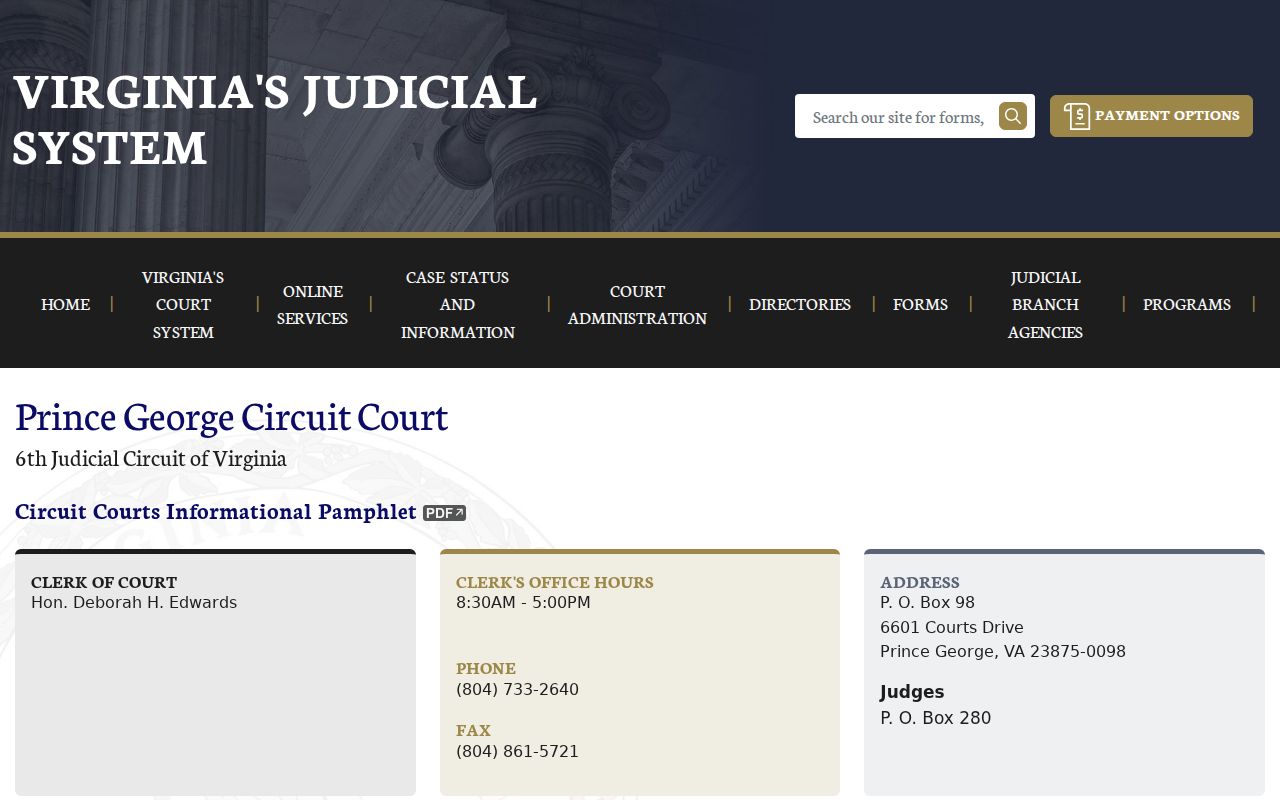
Prince George County's Circuit Court page identifies the court's channel. It is not a warrant roster or a result for any named person.
What a Prince George County Warrant Record Shows
Virginia's blank criminal forms show the fields a warrant may carry. They are document schemas, not a live sample. Read the court, process type, case number, charge or order, and service block together. Prince George County publishes no warrant-number format or bond schedule, so any sample number or amount would mislead.
| Issuing court | Circuit, General District, JDR, magistrate service, or another named jurisdiction. |
|---|---|
| Process type | Arrest warrant, summons, DC-360 show-cause summons, DC-361 capias, or other court process. |
| Case identifiers | Case number, tracking number, and Virginia Crime Code may appear on the official form. |
| Charge or order | The offense, code section, date, or underlying court obligation that led to process. |
| Issuer and dates | Issuing authority, issue time, hearing or return information, and any bail instruction. |
| Service and status | Officer and agency, service or return, and available case disposition details. Confirm current process with the clerk. |
Prince George County Warrant Office Split
Courts in Prince George County issue process and keep the file; the sheriff and police execute papers under their own authority. The Sheriff's Office lists criminal-paper service, courthouse security, inmate transport, and extraditions. County Police is a separate department. Its 24-hour non-emergency line takes police calls, not warrant questions, and no warrant desk is published. Split the work this way. Ask the clerk what the court file says, then ask the serving agency what it can tell you about service.
Prince George Sheriff's Office
6601 Courts Drive, Prince George, VA 23875
(804) 733-2690
Prince George County Police
6600 Courthouse Road, Prince George, VA 23875
(804) 733-2773
Who Issues and Serves Prince George County Warrants
Virginia Code §§19.2-71 and 19.2-72 set out who may issue arrest process and the sworn-complaint and probable-cause steps. Section 19.2-76 covers execution and return. The Virginia arrest-process chapter holds the state text. In Prince George County, the Sheriff's Office serves criminal papers, while the Police Department is a distinct law-enforcement agency. A court clerk keeps case records; the serving agency plays a different role. For Circuit felony files, call the Circuit Clerk. Traffic, misdemeanors, and felony preliminary hearings go to the combined General District clerk, and JDR matters use that clerk too, subject to confidentiality. The combined court page lists the current court and contact route.
DC-360 and DC-361 Prince George County Process
A missed appearance does not always produce the same document. General District Court materials describe DC-360 as a show-cause summons. DC-361 is a capias, titled “Attachment of the Body.” What the court issues depends on the case, the order, and the event. When a DC-361 is served, the General District Court Manual calls for custody, then presentation to a magistrate for a bail hearing. Prince George County publishes no local bond amount, intake location, or walk-in procedure. The Virginia criminal form index and JDR form index show the official form families. A form label still will not tell you whether someone's process remains open.
What to Do If You Have a Prince George County Warrant
Figure out which court issued the paper first. That answer shapes everything else. Call the clerk before you drive to any courthouse, jail, or police office. Ask whether the file shows a new date, an appearance requirement, a recall request, a show-cause hearing, or a bond instruction. Only the issuing court can recall a warrant or move the underlying case. The sheriff can answer a separate service or surrender-routing question, though Prince George County publishes no warrant counter or posted surrender hours. A lawyer can speak with the court about a permitted appearance, a motion, or a surrender plan. If custody happens on a capias, the statewide manual describes a magistrate bail hearing, and Prince George County posts no local bond schedule or accepted payment method. Keep your release paperwork. Then confirm the court record itself was updated. Release alone does not end the charge or clear every future court date.
Important: Call the issuing clerk and an attorney before a custody-related visit. Do not assume that a payment, online result, or sheriff call recalls court process.
Prince George County Has No Municipal Court City
Prince George County contains no incorporated city at all. The community called Prince George is a census-designated place, not a city with its own municipal court. Hopewell is an independent city that sits outside the county, even though both share the Hopewell–Prince George Crime Solvers program. That means no city police warrant line or city citation portal serves Prince George County. Traffic and misdemeanor process lands in General District Court. It is the local lower-court path for the whole county. The official Virginia local-government directory spells out which localities are incorporated. Census incorporated-place tables draw the same boundary.
Public Access to Prince George County Warrant Records
Virginia FOIA governs public-body records here. Court case records follow separate clerk-access rules. Prince George County accepts FOIA requests by mail, fax, email, in person, or phone. Describe the existing record you want with reasonable detail, and ask for a cost estimate before it is processed. The county does not have to create a new record or give a legal conclusion, and a warrant file held by a court goes to the clerk, not the county FOIA officer.
Key rules:
Virginia Code §2.2-3704 sets the public-body FOIA response process, including the five-working-day framework and permitted responses.
Section 2.2-3706 allows protected law-enforcement material to be withheld or redacted under stated exemptions.
Section 2.2-3703 excludes court records from FOIA; ask the appropriate clerk about public case files.
Prince George County FOIA and Clerk Requests
Not every records question goes to the same office. Virginia's clerk-record guide sends court record requests to the court clerk, under the clerk statutes and rules that apply. The County FOIA Officer handles records the public body holds, subject to exemptions. A good request describes an existing record. Name the office likely to hold it. State your preferred format and ask for an estimate. The county's FOIA page allows five working days for a response, with a possible written extension and actual search or copying costs. A FOIA request cannot recall a warrant. For the Sheriff's Office, ask what may be released, then use FOIA for a formal record request. The official county FOIA instructions name the County FOIA Officer for Prince George County.
The County FOIA page lists request methods, timing, costs, exemptions, and appeal information.
Use FOIA for qualifying county-held records; request court case files from the appropriate clerk.
Warrant Records by City in Prince George County
Prince George County has no city warrant pages. The reason is simple. No incorporated city or town exists inside its borders, and the Prince George census-designated place is not a municipal government. Hopewell stands outside the county as an independent city. Residents facing traffic or misdemeanor process should start with General District Court, since no municipal court records exist to route separately.
Prince George County Warrant Clerk Routes
The paper tells you where to go. A traffic summons or adult misdemeanor points to General District Court, and its combined GDC/JDR clerk sits at 6601 Courts Drive. A felony trial or appeal goes to Circuit Court. Its clerk is at 6601 Courts Drive, Suite 120. Juvenile, support, custody, and related JDR matters use the combined clerk's route, though public details can be limited. The shared campus does not merge the files. Follow the court printed on your paperwork, then ask that Prince George County clerk which public record or next date is available.